Thursday, June 23, 2011

The Language of the Dog Racing Industry

"Watch your thoughts, for they become words.
Watch your words, for they become actions.
Watch your actions, for they become habits.

Watch your habits, for they become character.

Watch your character, for it becomes your destiny."


-- Anonymous.
I have always believed that the fight over greyhound racing ultimately boils down to a very simple disagreement over how we perceive dogs. Most of us see dogs as living beings, companions and members of the family. On the other hand, the greyhound racing industry views dogs as commodities, or numbers to gamble on.

That is why greyhound breeders use terms like "producer" to describe breeding dogs. It is also why they refer to greyhounds in terms that relate solely to their financial value. For an example, look at this blog post published today by the Australian website The Dogs. In this post, The Dogs reports on a greyhound named Blue Lorian, who is being retired due to a shoulder injury. His owner is obviously sad about this turn of events, because Blue Lorian was a big money maker:
"Brendan and I thought he could have gone on for another 12 months, but at three-and-a-half years of age it’s the right thing to do ... We want him on all fours before we start breeding with him."
The blog post then reports that Blue Lorian has a nickname:
“The gift that keeps on giving”
Blue Lorian was given this nickname because he was a Christmas present, and also because he won $375,000 in prize money during his career. According to his owner:
“He got my head above water ... we tried to do the right thing with the kids education and whatever else, but we were always paying by credit card and then paying interest on the credit card. Now we’ve paid all the bills and whenever we put something on the credit card we pay it off straight away."
This attitude is typical in the greyhound racing industry. To many greyhound breeders and racetrack owners, greyhounds aren't even dogs at all.

That might sound like an exaggeration, but it's not. Don't take my word for it. Instead, take the word of former dog track owner Kelly Carney, who gave us her perspective on greyhounds during a 2008 debate over greyhound racing:
"Excuse me, but you're not talking about dogs. You're talking about greyhound racing pets right now. You're not talking about house pets."
At the beginning of this post, I quoted an anonymous author. I think this author got it exactly right. We have to watch our words, because they both reflect our thoughts and become our actions.

Friday, June 10, 2011

"The Greatest Producer Ever"

As part of our work at GREY2K USA, we closely monitor the greyhound racing industry. During this process, we frequently learn about industry standard practices and hear stories about past champion greyhounds.

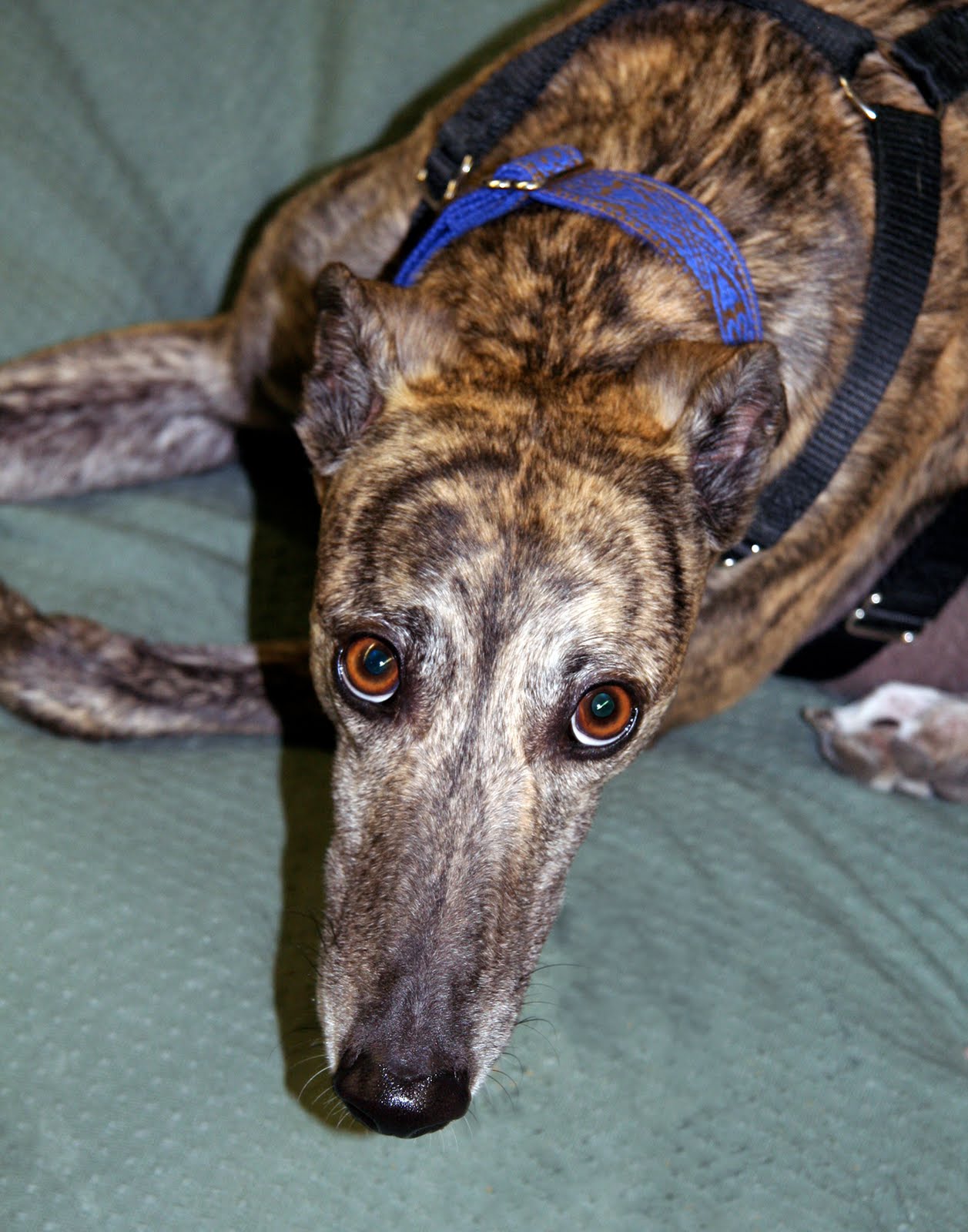
One sad example of a past champion greyhound is the story of Buzz Off. Born on January 15, 1984, Buzz Off was a brindle greyhound who was owned by greyhound breeder Ron Beckner. She was not successful as a racer, but was eventually inducted into the Greyhound Hall of Fame for her work as a brood bitch. During her life, she was bred 11 times and gave birth to 79 puppies. Two of her puppies won more than $500,000 in combined winnings.

In summary, Buzz Off was inducted into the Greyhound Hall of Fame because the racing industry made so much money off of her and her puppies.

Even more details about Buzz Off were recently disclosed in an on line discussion over at American Greyhounds, an internet forum used by the dog racing industry. In this discussion thread, titled "The Greatest Producer Ever," it was disclosed that Buzz Off only raced five times before suffering a broken leg, and was later bred "brother to sister in second generation." Here are a few excerpts:
"This dog was an act of God really. How many dogs would you ever see bred 11 times and produce unreal hall of fame dogs time after time."
"She almost wasn't bred back then. She had five races and two wins at Sarasota then broke her leg."
"In a conversation I had with Ron Beckner years ago, he said he really wanted to breed to Perceive ... He had debated on breeding Buzz Off at all, but when she came in, he said he called to see if Perceive was available out of habit and to his surprise he was. At that point he said he didn't care anymore if this was his worst brood prospect, Perceive was available and he was breeding to him. The funny part was that it was only after he hung up the phone that he thought to look at their pedigrees. He said his heart sank when he saw he was breeding brother to sister in the second generation, but then decided what the hell, he'd waited that long to get Perceive and he was going to go ahead with it."
"I just love reading these kinds of stories. Thanks Martin for all the info and thanks Remo for posting in the first place ... Does anyone know what became of Buzz Off after she was done raising her puppies?"
This discussion underscores the selfish view that greyhound breeders hold when it comes to these magnificent dogs. First and foremost, dogs are judged on their ability to generate a profit. If a greyhound generates revenue, either as a racer or breeder, the dog becomes an "Act of God." Their welfare is always a secondary concern.

I don't know what happened to Buzz Off (pictured at right and above), although records show that she was still being used as a puppy "producer" a few months before her tenth birthday. I hope she was given a few years respite on a couch somewhere. She certainly deserved it.

Thursday, June 9, 2011

Texas Racing Commission Responds to the Death of Crispin the Greyhound

Last week I wrote about the death of Crispins Place, a champion greyhound who died in February after suffering a broken leg at Gulf Greyhound Park in Texas. According to state records, Crispin did not receive veterinary care until two days after his injury, causing him to be subject to "unnecessary suffering." For this "inhumane treatment," trainer Criag Edwards was fined a paltry $500 and not suspended for even a single day.

After learning of Crispin's death, we wrote to the Texas Racing Commission to express our disappointment in the handling of this incident, and urged officials to reopen the case and consider handing down a stiffer penalty. We have received a formal response to our letter, which contains information that is both encouraging and worrisome.

To begin with, Texas Racing Commission Executive Director Chuck Trout states that he does not have the legal authority to reopen the case of Crispin's death:
"Under the Texas Racing Act and the Commission's rules, a decision of the stewards or judges becomes final unless appealed within three days of issuance by the affected licensee. Since Judge's Ruling Gulf 962 was issued on March 18, 2011, it became final on March 21, 2011, when Mr. Edwards did not file an appeal. The Commission therefore no longer has jurisdiction to reopen the case."
The Texas Racing Commission certainly has an obligation to follow the law, even when the law is flawed. But is this really the law? Mr. Trout's position seems to directly contradict Texas Administrative Code RULE §307.69, which reads:
"On its own motion or on request by the executive secretary, the Commission may reverse a decision of the stewards or racing judges, modify a penalty imposed by the stewards or racing judges, or reinstate a person's license and rescind the penalty."
In any event, Mr. Trout then acknowledges that the Commission needs greater authority and "management of field staff":
"While all of the agency's stewards and judges are very capable and experienced, the Commission recognized during Sunset reviews that the Texas Racing Act could be improved by providing for additional management oversight of field staff."
Trout then writes that this "management oversight" will soon be given to the Commission under a newly passed law, and writes:
"While this change would not authorize me to revise past decisions, my ongoing reviews of decisions will be accompanied by the authority to make adjustments where necessary to ensure that the Act and Rules are enforced consistently and effectively."
In other words, Trout claims that the Texas Racing Commission does not have the authority now to reopen the case of Crispin's death, (although the Administrative Rules say otherwise), but it will have this authority soon, and the Commission acknowledges they need this authority to make sure the Rules are enforced "consistently and effectively."

Despite the fact that the Commission does apparently already have the authority to act in this case, it is good news that the Commission is seeking greater legal powers. It is important that dog track regulators have all of the tools available to do their jobs, and improved oversight will undoubtedly help greyhounds.

The next paragraph in Mr. Trout's letter, however, is deeply troubling:
"With their knowledge and experience, the judges are in the best position to determine the appropriate level of penalty that will both punish the individual and deter future, similar violations by the regulated community."
With all due respect, this bizarre set of positions is nothing short of schizophrenic. In one paragraph, Trout states that the judges are in the "best position to determine the appropriate level of penalty," while in another paragraph states that the Commission acknowledges the "Texas Racing Act could be improved by providing for additional management oversight of field staff" and has repeatedly asked lawmakers for the authority to overrule the judges.

There is more to Trout's letter, however. He continues:
"In this case, the fine imposed by the board of judges is the highest monetary sanction imposed at Gulf Greyhound Park in more than two years."
If Mr. Trout and the Texas Racing Commissioners believe this penalty was appropriate, then they are simply out of touch. Here are the facts: a champion greyhound named Crispin Place suffered a catastrophic injury. He did not receive veterinary care until two days later. The Texas Racing Commission officially termed this "inhumane treatment" that caused Crispin "unnecessary suffering." For this "inhumane treatment," greyhound trainer Craig Edwards was fined $500 and not suspended for even a single day.

Finally, Trout ends his letter as follows:
"I have directed the judges to meet with both the kennel and management of Gulf Greyhound Park to verify that veterinary care is readily available at all times and to impress upon all trainers that necessary medical attention may never be delayed for any ill or injured animal. It is my expectation that all parties will take steps to ensure that there is no recurrence of this event."
For the greyhounds now racing at Gulf, I hope the "steps" referenced by Mr. Trout are real and concrete. Regardless of how any of us feel about greyhound racing, the "unnecessary suffering" that Crispins Place was subjected to is inexcusable.

Unfortunately, the Texas Racing Commission is sending mixed signals about its willingness to address this problem. It is good the Commission is seeking greater authority, and asking the track and kennel operators to take steps to prevent this from happening again. At the same time, its defense of this slap on the wrist penalty sends the message that there really is no substantive punishment for greyhound cruelty in the Lone Star state.

Tuesday, May 31, 2011

Will the Texas Racing Commission Stand Up for Crispin the Greyhound?

Yesterday, the Galveston County Daily News reported on the death of Crispins Place, a two-year-old brindle greyhound who died last February.

Crispin was a champion racer. In 2010, he won the Hollywoodian stakes race in South Florida, and was nominated by the National Greyhound Association for the Flashy Sir Award as one of the fastest distance racers in the country.

Sadly, Crispin's success did not protect him from being neglected when he needed help the most.

On Valentines Day, Crispin suffered a broken leg during an unofficial schooling race at Gulf Greyhound Park. When this serious injury occurred, it was the responsibility of trainer Craig Edwards to make sure Crispin received prompt veterinary care. However, according to state records:
"Mr. Edwards failed to seek medical treatment for the greyhound until 2/16/11 thus subjecting the greyhound to unnecessary suffering."
As shocking as this neglect is, what happened next may be even more disturbing. Although the Texas Racing Commission officially ruled that Crispin had been the subject of "inhumane treatment," they only fined Edwards a paltry $500, without suspending his license for even a single day.

This penalty is clearly insufficient, which is why we wrote to the Texas Racing Commission two weeks ago and asked them to reopen this case and consider handing down a stiffer penalty.

Strong regulatory agencies can greatly improve the lives of greyhounds. They are the first line of defense in preventing severe cases of cruelty and neglect, and greyhound advocates owe them a debt of gratitude. However, the system fails every time a regulatory agency shirks its responsibility, or loses sight of the fact that it must be an independent regulator of greyhound racing rather than a promoter.

I am grateful to the Galveston County Daily News for their front page story reporting on this important issue, and also to GREY2K USA Research Director Catherine Vassighi for her work in bringing light to this case.

Now it is up to the Texas Racing Commission to do the right thing. Its response to our letter will send a clear message about whether they take the welfare of greyhounds seriously, or not.

Tuesday, May 24, 2011

Greyhound Protection Efforts Advance in Alabama, But More Work is Left to Do

Last week, greyhound protection efforts in Alabama took a big step forward when VictoryLand Greyhound Park announced that it is ending live greyhound racing on June 1.

The end of dog racing at the track, which has held races for more than a quarter of a century, is the result of a bizarre sequence of legislative intrigue, State Police raids, and federal indictments. In a few weeks, VictoryLand owner Milton McGregor will stand trial on charges that he allegedly conspired with others to buy and sell votes in an attempt to legalize slot machines. Ironically, the track had already installed thousands of slot machine-like devices it was using to prop up greyhound racing. Now the slot machines have been removed, McGregor faces federal charges, and greyhound racing is ending.

As important as this victory is, there is a tremendous amount of work left to do for greyhounds in Alabama. There are still two tracks left in the state, Mobile Greyhound Park and Birmingham Racecourse.

At these tracks, hundreds of greyhounds endure lives of confinement and suffer serious injuries. Also, in recent years several troubling cases involving drugs have been documented in the Alabama dog racing industry. For example:
  • On October 20, 2009, a greyhound at Birmingham Racecourse tested positive for cocaine. As a result, the trainer responsible for the dog was suspended for 60 days by the Birmingham Racing Commission.
Greyhounds in Alabama are also subjected to a regulatory system that is broken and badly in need of reform. The $50 fine handed down by the Mobile Racing Commission in 2009 for a cocaine positive greyhound is outrageous. Further, the Mobile Racing Commission has refused to make greyhound injury reports available to the public. Unfortunately, these are only two examples of the lack of oversight that is frequently demonstrated by Alabama track regulators. In particular, Mobile Racing Commission executive director Kip Keefer has repeatedly proven that he views his job as representing dog track owners, rather than the general public.

A former dog track executive himself, Keefer has repeatedly dismissed any legitimate criticism of Alabama's dog tracks. When media reported on the Mobile cocaine positive in May 2010, Keefer told greyhound breeders in an on line forum that the news story was an "8 month old pile of garbage." In another message, he gave greyhound breeders specific directions on how they should respond to greyhound protection groups like GREY2K USA:
"Anytime this industry is attacked the response must be swift and non-defensive in nature."
In response to this message, greyhound breeder Wendy Brotherton told Kip that he was doing a "good job," and said that the greyhound racing industry needs "to get real 'cozy' with the media in areas in order to get them to contact us FIRST before publishing anything detrimental" to the racing industry.

Keefer also publicly defended track owner Milton McGregor as recently as October 2010, authoring a letter in the Birmingham News in which he wrote:
"I have had the privilege of working for and with Milton McGregor off and on over the past 20 years. I cannot think of anyone who possesses more honesty and integrity."
Thankfully, there is reason to hope that the future is bright for greyhounds at Birmingham and Mobile. In recent years, new allies have spoken up for these dogs.

Most notably, GREY2K USA Vice President Jennifer Krebs has become the most prominent voice for Alabama's greyhounds. A former adoption volunteer who rescued greyhounds from Birmingham, Jennifer has personally seen the cruel and inhumane treatment dogs are subjected to, and writes frequently about greyhound protection issues in Alabama on her blog, Living the Greyt Life.

The greyhounds are also fortunate to have allies like Joe Godfrey of the Alabama Citizens Action Program and Mindy Gilbert, State Director for the Humane Society of the United States. In fact, greyhound protection efforts in Alabama are picking up steam every day, with more opinion leaders, bloggers, and humane advocates joining the fight.

With allies like these, I am convinced that our best days in Alabama are ahead of us, and the closure of VictoryLand is just the beginning.

Monday, May 9, 2011

Looking Forward for Florida's Greyhounds

Last week, a bill to decouple greyhound racing from other forms of gambling (House Bill 1145) stalled when it was not brought up for a vote on the final day of the Florida legislative session. This lack of action defeated the bill, despite the fact that it had already been approved by both the state House of Representatives and Senate.

This was an important proposal that would have significantly decreased greyhound injuries in the state and reduced the number of greyhounds that endure lives of confinement. Because it would have done so much good, its defeat is heartbreaking.

However, the progress we made in this campaign should also give us reason to hope.

Our decoupling bill stalled due to purely technical reasons, after greyhound advocates had decisively won the policy debate. In the House, the greyhounds won by an overwhelming 86 to 31 margin, while the Senate similarly supported greyhound decoupling by a solid vote of 25 to 14. Newspapers from across the state editorialized in favor of greyhound decoupling, including the Orlando Sentinel, South Florida Sun-Sentinel, Naples Daily News, Tampa Tribune, and Panama City News Herald.

Thousands of grassroots activists in the Sunshine State called, e-mailed, and visited with their lawmakers on behalf of the greyhounds. These grassroots supporters were the heart of our effort, and our success was due in large part to their participation and commitment.

Through this effort we also discovered new allies for the greyhounds, including compassionate lawmakers who are committed to fighting for the dogs. Most notably, State Representative Dana Young proved herself to be a powerful advocate of this common sense bill, and the greyhound protection community owes her a debt of gratitude for her hard work.

I am also grateful for the work of the Greyhounds First Coalition, a joint effort by animal protection groups and adoption organizations including Greyhound Adoptions of Florida, USA Defenders of Greyhounds and the National Greyhound Adoption Program. While greyhound breeders were using scare tactics with lawmakers, these groups demonstrated true leadership. They let legislators know that greyhound decoupling is an opportunity to help even more dogs find loving homes, and they were prepared to step up and participate in the transition.

Despite this temporary loss, it is inevitable that greyhound racing end in Florida. Since 1990, tax revenue from live dog racing has declined by nearly 97%, and many tracks are losing money on dog races. At these tracks, greyhound racing only exists because the state mandates that a set number of live races be held in order to offer other forms of gambling. This mandate has effectively become a state subsidy for greyhound breeders, creating an artificial market for their failing businesses.

Greyhound racing will also end because it has lost public support. More people know about the cruelty of greyhound racing than ever before, and lawmakers are responding to this increase in public awareness.

The question has become when, not if, greyhound racing ends in Florida. So while I grieve the dogs that could have been helped by this year's decoupling bill, I also know that as greyhound advocates our best days are ahead of us.

Friday, April 1, 2011

A Birthday Wish for Zoe the Greyhound

Today, my adopted greyhound Zoe turns nine.

While meeting with Florida lawmakers in recent days, I have joked that she might be angry with me for being away on her big day. All kidding aside, I do miss her. While I am working for the greyhounds in the Sunshine State, she is staying with a close friend who also has a rescued greyhound. When I called today to see how Zoe was doing, my friend told me how excited Zoe was this morning when, on her early walk, she saw several inches of new snow on the ground.

Living with Zoe has given me a greater understanding of and empathy for all greyhounds. She inspires my work, and every day living with Zoe is better day because of her.

Happy birthday, Zoe.